

It’s a bad year for non-interventionists.
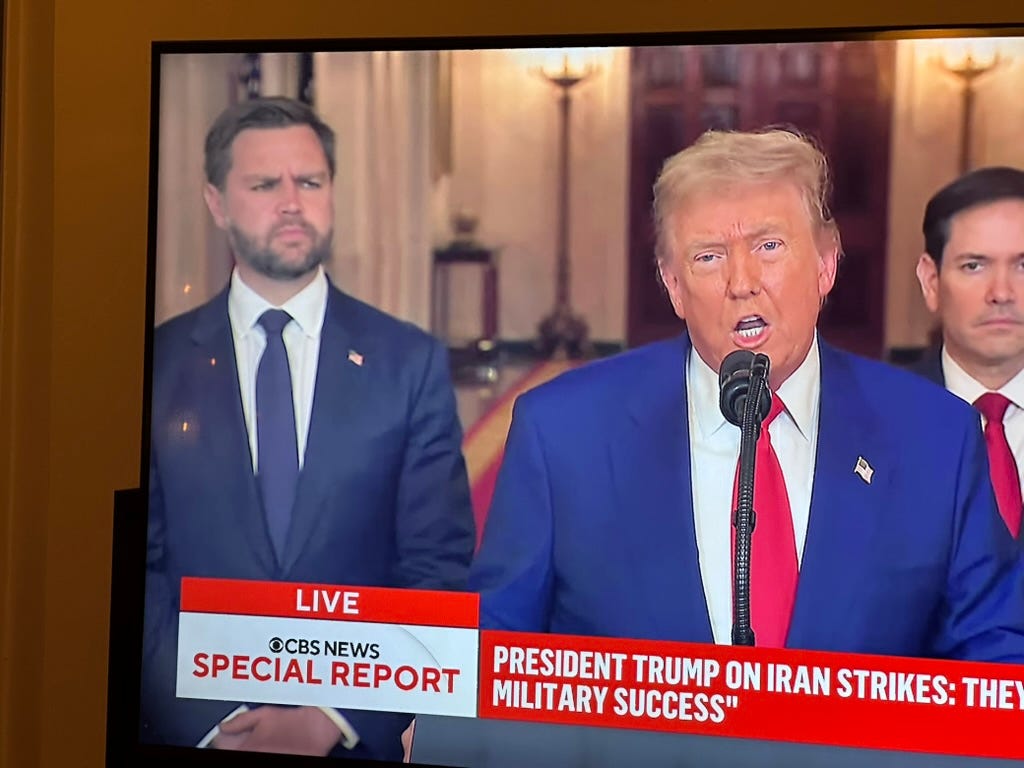
For the second time in three months, what would normally be a presidency-defining military conquest has become a weekend story. Iran’s longtime near-messiah-like Supreme Leader Khamenei is dead, as are senior officials throughout the Iranian regime. With that comes the complicated headlines when a dictator is overthrown. Like with Maduro, and going back further to leaders like Gaddafi and Saddam Hussein, there should be no equivocation about the evilness of their regimes - and no false equivalencies between those absolute dictatorships and our troubles in the west with authoritarian populists.
Many within the media and in non-interventionist circles are pointing out the disconnect between the president’s campaign message of “no new wars” and having launched more new wars than any president since Bush. You could write that off as simply a Trump lie - another of hundreds. But this is a little different than his out and out lies. It’s become very clear throughout the second term foreign policy that Trump sees a “war” as something different than what you or I might see it as. Trump sees a “war” as a military occupation, a boots-on-the-ground combat operation. Many non-interventionists and anti-war candidates flocked to Trump as one of the most vocal modern opponents of the Iraq and Afghan wars that dominated the 2000s, but it was not the war that Trump criticized. It was how it was carried out. Many of us pointed out that Trump’s criticism of the Bush-era wars were not that we went in the first place, but that we didn’t fight hard enough, we didn’t exploit them for their natural resources, and we tried to build a democracy rather than focusing mainly on stability.
This is the essence of a cohesive Trump Doctrine. America has the military might to push other countries into doing what we want. Unlike the old adage of “speaking softly and carrying a big stick,” Trump believes in using the stick of our military to threaten and coerce traditional allies and enemies alike into getting what he wants. Sure, this is not exclusive to Trump, much of the Cold War was fought the same way. The difference with Trump is that because he doesn’t care about the rule of law, he doesn’t care about (or particularly like) democracy, he has vastly increased authority and is taken more seriously than previous presidents. And in his mind, this is a good thing - they were “idiots,” he is the only one who is willing to act to “defend America.” He is an authoritarian, and he is unfortunately far from alone in seeing the ability to single-handedly make decisions without political or popular input as an advantage of authoritarianism.
The Trump Doctrine has other advantages politically and strategically for him. Unlike the nation-building Bush Doctrine, Donald Trump doesn’t want to invade countries with hundreds of thousands of American troops. Like in Venezuela, surgical strikes to take out leaders is used to eliminate those opposed to him and threaten those that remain. He doesn’t care if the remaining government is still a horrific dictatorship, as long as they obey him and what he wants. That makes stability much easier than Bush’s ill-fated attempts at building multi-cultural democracies in the Middle East. It also makes the wars seem much farther off and irrelevant to Americans. Bush’s approval ratings began to tank as more and more Americans were sent to Iraq, because the war touched everyone. Trump is banking on Americans seeing the “wisdom” of his strategy, eliminating household named enemies like Iran and Venezuela without mass American casualties.
Ironically the modern president with the most similar viewpoint on military strikes was Donald Trump’s arch nemesis, Barack Obama. Obama similarly campaigned as an anti-war candidate, and was criticized heavily from the left and libertarians for stepping up bombing campaigns across the Middle East, opening a new front in Libya, and the infamous drone strike campaign. However unlike Trump, Obama at least paid lip service to the rule of law and Congress’ war authority. While many (including myself at the time) criticized him for not seeking Congressional authority in Libya, he did seek authorization for a potential campaign against Assad in Syria after the dictator crossed his self-described “red line” by using chemical weapons against rebelling Syrians. Congress never approved that authority, and Assad continued in office for another decade.
The right-wing press saw Obama’s failure to do anything as a capitulation, a sign he was a weak-kneed leader who refused to defend America. Never mind the authorization he sought was voted down primarily by the right (including, to be clear, libertarians and non-interventionists which I supported). This is the key difference between the Obama and Trump Doctrines. While they both relied on targeted military operations against specific targets instead of wholesale nation-building, Trump has little care for international agreement, or his own constitutional restrictions in war authority. This advantages him, since other nations now know that he can and will use the American military to get what he wants. They can not rely on the slow and hesitant Congress to hold up potential action.
There will be those who read this as a defense of the “Trump Doctrine,” and that is not the case. As I wrote after the Venezuelan invasion, war authority belongs to Congress because in a democracy, war authority belongs to the people. Trump didn’t seek support from the American people to commit the country to two separate military interventions, and early polling shows the American people (that are aware of what’s going on - a separate issue in our fragmented media world) largely oppose him in this endeavor. But if he ”succeeds” (even short term) with Iran, he won’t stop with Iran and it is important to understand how his administration is thinking about their own military actions.
As I wrote back then, being a non-interventionist can easily slip into defense of incumbent authoritarian regimes around the world, and I can’t stand that lack of nuance among some particularly on the far-left and far-right libertarian world. You can support the Iranian people’s fight for freedom, the Venezuelan people’s fight for freedom, etc. without supporting a military invasion or decapitating strikes. I came into libertarianism through anti-war activism in the late 2000s, and I still fundamentally belief that the issue with using the military and violence in favor of “democracy and freedom” is that when chaos and violence occurs, it’s very hard to stop and rarely does freedom and democracy win out of the fog of violence and chaos.