

And now for something completely different.
When I started this site, I had intended to include coverage of the changing media landscape and it’s affect on the country and society. I grew up loving broadcasting, TV and radio, and when other kids wanted to be doctors or whatever, I very specifically wanted to be a late night TV host. I had the good fortune to know quite a few people who worked in local TV and radio when I was younger, however, and let’s just say that my love for broadcasting was overridden by my love for actually making a living wage.
But I will connect broadcasting, the future of media, Formula 1, and the future of democracy! I promise!
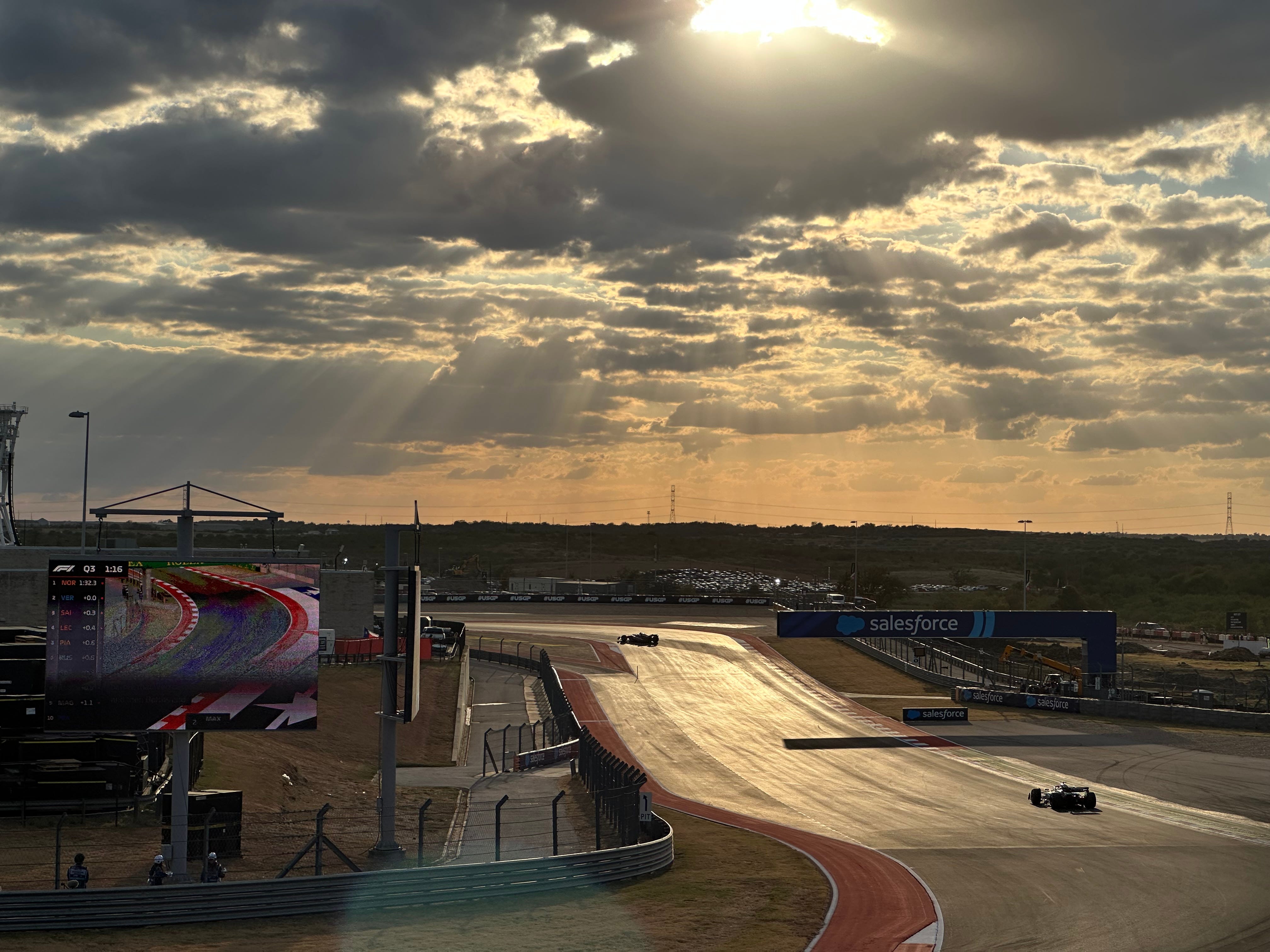
As you know if you are also an F1 fan, Apple took over U.S. broadcasting rights for F1 this year from ESPN/Disney. This past week was the second race of the season in China, and overall I would judge Apple TV positively. American F1 fans had two options previously to watch the sport: ESPN aired Sky Sports UK simulcasts of F1 sessions on their cable channels, along with occasional broadcasts on Disney-owned corporate sibling ABC. Fans that wanted more options could subscribe to F1TV, the sport’s owned-and-operated streamer, which cost around $100 a year for full access to all sessions, 4K stream quality, and onboard cameras along with a separate commentating crew and on-air pre-and-post show talent. Apple kept F1TV alive in the U.S. and primarily airs their content on their Apple TV main app, as well as providing access to the Sky Sports commentary and feed.
Nonetheless, the move of a (albeit in America minor) sport to streaming only signals another death blow to traditional broadcast TV, at a time when media consumption continues to splinter. One major concern for F1 fans and those of us who want to see the sport continue to grow is exposure. The previous ESPN deal allowed F1 to be viewed on cable (which just under half of American households still subscribe to) and occasionally on broadcast TV, which exposed the sport to people who had maybe never seen it before or only heard of F1 from the popular Netflix reality show Drive to Survive. The Apple deal isn’t unusual internationally - the UK, the spiritual and literal home of F1, has the sport behind a significant paywall through a Sky Sports subscription. But that can be done with a very popular sport, like we do with much of the NFL in America, and not so much with a sport that is relatively niche but growing like F1 is in the U.S.
There may yet be solutions to that for Formula 1. Already, Apple has announced a deal with Netflix to air the Canadian Grand Prix to their subscribers. I would not be surprised for Disney (which has a historically close relationship with Apple) to announce a deal for some of the American races and/or the famous Monaco Grand Prix to air on ABC, free-to-air, as they did when most races aired on their corporate sibling ESPN. If those don’t materialize, it will be a strong test for whether we are truly in a post-broadcast era: can F1 increase their viewership behind a paywall based on social media clips and on-demand streaming races?
There is a bigger societal impact to the move away from linear television broadcasting and towards algorithmic on-demand streaming services. There have been hundreds of articles bemoaning the loss of “water cooler TV,” when people would all watch the same few TV shows and discuss them the next day. Truthfully that still exists - most people are getting their streaming recommendations from other people, after all - but what is missing is the ability to discover and see things you normally wouldn’t watch. To be exposed to sports or TV or news that you wouldn’t self-select. To those of us that grew up loving broadcasting, the curation is part of the charm. It’s also part of what binds a society together. Not that we are all watching the same thing, but it’s that people are getting exposed to music and cultures other than what they normally select.
The controversy around the Super Bowl halftime show is an example of this. There were some that freaked out because they are right-wing agitation professionals and that’s just what they do. Yet others genuinely aren’t used to seeing or watching anything that doesn’t instantly agree with them and their worldview. In a previous decade making fun of (or grousing about) the Super Bowl halftime show was a tradition itself, now people simply tune it out and view their own. And that’s for one of the few major TV events that continues to dominate the national stage.
On a darker note you can also take President Trump’s announcement of the war on Iran. During the last major war two decades ago, President Bush dominated national TV with speeches and the national TV networks covered the war in prime time. With this war, Trump issued a video statement on his own social media service in the middle of the night. Americans are freer than ever to curate their own exactly tailored TV and radio broadcasts, with only the information they want to hear and tuning out the news or culture they don’t. That is allowing some to be more polarized and live in an alternative universe, and more significantly it is causing many Americans to be able to tune out the news altogether. It’s also bad in other ways beyond information silos. Without trusted media sources, for example, it becomes harder for many people to assess the truth.
Take weather broadcasting, for example. One trend as local news stations face massive cuts is for major broadcast meteorologists to go it alone and launch their own YouTube and websites. With far lower overhead, they can provide more live-saving weather content without the constraints of a typical TV station. This has been a success story moving away from traditional media to continuing local journalism in the new era. But they also are on an even playing field with YouTube grifters - often not meteorologists at all - who get massive views on playing up model runs for clickbait. It’s easy to see who to trust right now as many of these meteorologists came from local TV and have a brand themselves, but in ten or twenty years, will the average person who goes on YouTube to learn about the snowstorm they heard about know how to differentiate between them?
Media literacy is often brought up as the answer to this, and I don’t disagree. Right now there is a massive lawsuit against social media companies, which has often been compared to the lawsuits against the tobacco companies in the ‘90s. I’m not taking a side on that case: I broadly think the issue isn’t social media but the people behind the keyboard. But just as the Tobacco Master Settlement of the ‘90s forced the cigarette manufacturers to spend billions on education campaigns about their products, if there is an analog, perhaps funding a nationwide school-level campaign on media literacy would be a positive outcome. Of course as a libertarian, I then get into the second-order implementation issue: who would actually create the curriculum, and would you trust this government or the social media companies themselves to do it?
As a product, I do think there are improvements that can be made to the streaming services as well. Ironically one of the best streaming services for this is HBO Max, which continues to air HBO’s linear content through both cable and the streamer. So you can tune into HBO and watch whatever is on. But as soon as a show starts to air on the linear stream, it goes live on-demand as well. Apple would be well suited to this as well, their Apple TV service has a smaller back catalog and a few live sports like F1, soccer, and baseball. They could do their own 24/7 sports network (which they do ironically with Apple Music 1 on their Apple Music service) and still have the on-demand component as a best of both worlds scenario. Each major TV network has an associated streamer (ABC/Hulu, CBS/Paramount, NBC/Peacock) that sorta does this, except in most cases the content isn’t available same day or live streams are restricted due to cable and broadcaster contracts.
I’m not of the opinion that live, linear TV broadcasting has to die nor should it. It’s part of a national and societal identity. That doesn’t mean it has to force conformity in any way, actually the opposite: social media and streaming, rather than it’s intention to create and platform new voices to everyone, puts many Americans deeper in an information silo. In the end, there will be platforms that recreate what was successful about mass media of old while adapting to on-demand and niche content that still allows a wide audience to get a window into the world together. It probably won’t be the media conglomerates of yesterday, and it won’t be the social media algorithms of today, but it will be something new and will be a part of what comes out of this era of America.